Showing posts with label journal. Show all posts

Wednesday, May 5, 2010

Pictures of the frame

A picture is worth a thousand words... in a deliberate effort not to overwhelm you with too much information, I will therefore just let you enjoy the pictures of the finally assembled frame! But before that, let me thank Doi-san for his great design and work on the frame: very nice job, Yoshi!


Tuesday, May 4, 2010

Pineapples, pineapples!

On my way back from NY last Sunday, I played with my Python SCExAO simulator to get a feeling for how a phase map on the deformable mirror (DM) gets remapped by the PIAA. The grayscale picture shows the focal plane image resulting from a double cross sinusoid on top of a flat DM. Without the PIAA, you expect to see your usual PSF surrounded by a regular grid of speckles whose separation depends on the number of sine waves you can generate across the DM and whose brightness depend on the amplitude of the sine wave. If the guys from SEEDS read this post, this may remind them of what the grid mask they want to put in HiCIAO will do...


With the PIAA, things of course get really different and your regular grid gets turned into a nice display... of pineapples! I just showed this morning the corresponding picture to a friend who was staying at our house. The laptop was on the kitchen table, and half joking, he pointed out that the picture looks just like the Hawaiian quilt pattern that's printed on the the kitchen tablecloth asking me whether I had done it on purpose... what do you think?


Thursday, April 22, 2010

Modeling of SCExAO


Building the actual thing is not enough: a numerical model of any experiment is also essential to understanding what's going on inside... SCExAO doesn't escape this general rule and we are working on this model these days!

Doing this is always very interesting and really makes you think about the minute details of all of the optics that currently lie on the bench. And SCExAO involves some pretty tricky components: pupil remapping devices like the SRP, the PIAA and the inverse PIAA are really peculiar optics, and the deformable mirror is a surprisingly complex little thing... but we're getting there!

Just like with the experiment control GUI, we've decided to program this model in Python. It's just been a couple months since we started playing with this, but the deeper we dig, the more we find! Numpy, Scipy, Matplotlib and Pyfits form together a great scientific programming environment that, once you get used to it, does just as well as IDL, which I have been using for the last couple of years.

The picture shows the kind of things this simulation produces: point spread functions (PSF) for different off-axis sources (1,5,10 and 20 lambda/D). Although not finely tuned yet, the model nicely reproduces the pineapple-shaped PSFs that SCExAO generates for off-axis sources with the PIAA only, as published by Lozi et al. (2009).

Wednesday, April 14, 2010

Frame update


I just thought I'd share some updates on the construction of the frame. While some parts are being made at the machine shop, Doi-san is assembling others to the frame... Today, he is working on the vibration damping system that will hold racks for the electronics of SCExAO and HiCIAO.

About two hundred holes need to be drilled to the frame to attach this very cool contraption by Yoshi Doi-san.

By the way, Yoshi is also a talented musician who plays Hawaiian music: ukulele and slack key guitar, and makes his own music instruments. You can follow Yoshi's musical adventures on his Youtube channel.

Monday, March 22, 2010

SCExAO Frame delivered!


Last week, the frame that will carry SCExAO when at the telescope was finally delivered to Subaru HQ! The big white painted welded steel structure that looks sturdy enough (thanks to Doi-san for the design!) now sits in the Subaru Simlab, ready to host the SCExAO bench, the HiCIAO camera, all of the necessary electronics and computers with spare room at the Subaru Telescope IR Nasmyth platform.

There is still a fair bit of work to be done on the frame: attachment holes to be drilled, pads for the frame resting on the floor and rails for lateral positioning of the instruments... but this is a big part of the project and having it finally delivered after over a year of discussion and design is quite a relief!

Wednesday, February 3, 2010

Good and bad news for SCExAO

No post in January... what's going on with the project? Let's start with some good news: in December, the SCExAO project was reviewed by a Subaru Telescope committee. Late January, the review report was sent to the Director who recommended to give SCExAO at least one night in the semester S10A, likely in May or June, before the telescope summer shutdown for re-coating of the primary mirror... yes!

The bad news is that only two days after this decision was announced, Subaru's AO system experienced a major problem, which permanently damaged the deformable mirror, making it unusable. The AO group at Subaru is working hard on trying to bring the AO back to life, however the replacement mirror won't be delivered before the end of October, which means that SCExAO is unlikely to go to the telescope before 2011.

While this is clearly a disappointment, we just have to make good use of this time. We have plenty of things to do: integrate and test the new frame for SCExAO and HiCIAO, which should be delivered toward the end of February (this month) is a major item on the list, write and polish the existing software for the control of SCExAO is another.

A hui hou!

Saturday, December 19, 2009

SCExAO will be at SPIE (part 2)

Just like the title of the post says: part 2 of our massive submission of abstracts for the the next astronomy SPIE conference.


Olivier submitted:

The Subaru Coronagraphic Extreme AO (SCExAO) system: Wavefront control and detection of exoplanets with coherent light modulation in the focal plane

The SCExAO system is designed to enable high contrast imaging at small angular separation (less than 0.5”) in the near-IR. It receives light from Subaru Telescope’s AO system and includes a second step of wavefront control and a high performance PIAA coronagraph. Light is then sent to the HiCIAO camera. For wavefront sensing, SCExAO uses a MEMS type deformable mirror to introduce known diversity in the pupil phase. The corresponding modulation is detected in the science focal plane, and leads to a measurement of the residual wavefront aberrations. The same modulation is also simultaneously used to differentiate residual scattered starlight (which is coherent with the light introduced in the focal plane by the modulation) from actual sources (planets, disks).

This combined wavefront control and coherent detection scheme is ideally suited for detection of faint companions at small angular separation. Detailed numerical simulations and recent laboratory results show that this techniques can calibrate and remove static and slow speckles which traditionally limit high contrast detections. A visible light lab prototype system at Subaru Telescope recently demonstrated speckle halo reduction to 2e-7 contrast within 2 lambda/D, and removal of static coherent speckles to 3e-9 contrast.

Frantz submitted:

The Subaru Coronagraphic Extreme AO system: progress report

In 2009 our group started the integration of the SCExAO project, a highly flexible, open platform for high contrast imaging at the highest angular resolution, to be inserted between the coronagraphic imaging camera HiCIAO and the 188-actuator AO system of Subaru. In its first version, SCExAO combines a MEMS-based wavefront control system feeding a high performance PIAA-based coronagraph, that suppresses the central obscuration and the thick spider vanes while preserving throughput and angular resolution. It also includes a coronagraphic low-order wavefront sensor, a non-redundant aperture mask and a visible imaging mode, all of them designed to take full advantage of the angular resolution (40 mas in the H-band) that an 8-meter telescope has to offer.

Friday, December 18, 2009

Group pictures for December 2009!


Today, Vincent is leaving Hawaii to France for his "X-mas break"... because when he gets back in January next year, others will have left for good, we took a couple group pictures. The first one was taken in the office and from left to right you have: Frederic Vogt, Kaito Yokochi, Vincent Garrel, Frantz Martinache, Olivier Guyon and Takashi Yoshikawa. The second one was taken in the Subaru Simlab, right in front our our SCExAO clean booth. From left to right you have: Frantz Martinache, Frederic Vogt, Olivier Guyon, Vincent Garrel (standing), Kaito Yokochi and Takashi Yoshikawa.


Happy holidays Vincent and see you next year!!

Thursday, December 17, 2009

Optical design schematic

Kaito Yokochi just made this nice schematic of the lab configuration of the SCExAO coronagraph. It'd be a pity not to post it here... thanks Kaito!

Wednesday, December 16, 2009

Cover panels snug fit

The protection cage introduced in a previous post was just a prelude... now we have some pretty good looking slick black panels to protect the bench from dust, light and coffee spills to complete the cover... take a look (picture courtesy of Takashi):

You may notice the transparent panels on the right side of the picture: it happens fairly regularly that visitors show up in the lab and want to see what the experiment looks like. We figured that a sneaky double panel system (transparent underneath the black) would let people see the guts of SCExAO and still protect the bench from things like unsuspected screwdriver attacks.

Before we complete the enclosure (on the sides), we need to neaten all the serial and USB cables that connect to the motors, actuators and cameras mounted on the bench.

Tuesday, December 15, 2009

The SCExAO project will be at SPIE (part 1)

Yesterday was the deadline for the submission of abstracts for the next SPIE Astronomical Instrumentation conference that will be held in San Diego, CA from June 27 to July 2, 2010. Pretty much everyone in the group decided to submit an abstract so I thought it'd be fun to gather them all here, as they draw a fairly coherent picture of the project... enjoy!


Frédéric submitted:

The Subaru Coronagraphic Extreme Adaptive Optic (SCExAO) system : implementation and performances of the Coronographic Low Order Wave-Front Sensor

In order to achieve high-contrast imaging at small working angles using the HICiAO camera on the Subaru telescope, a Phase Induced Amplitude Apodization (PIAA) Coronograph system is currently being assembled. The Subaru Coronographic Extreme Adaptative Optic (SCExAO) system, scheduled to be installed on the telescope early spring 2010, is located between the Subaru Adaptive Optic system (AO-188) and the recently commissioned HICiAO camera. It is designed to achieve a 1e-6 contrast at separations less than 0.5". This high contrast coronographic imaging requires an accurate control of low order wave-front aberrations, such as tip-tilt and focus errors. Simulations and laboratory prototyping have shown that a Coronographic Low Order Wave-Front Sensor (CLOWFS), which uses a single defocused image of a reflective focal plane ring, can measure tip-tilt to an accuracy of 1e-3 lambda/D. We report the implementation and performances of the CLOWFS on the SCExAO system. Using both the CLOWFS camera as well as the science camera in the system, we quantify the accuracy of this system and its ability to successfully remove tip-tilt errors from the science image. We show that CLOWFS measurements can be used in post-processing to accurately remove coronographic leaks due to residual tip-tilt errors. We finally deduce the maximum contrast to be reached using the SCExAO system alongside the HICiAO camera and the AO-188 on the Subaru telescope.


Kaito submitted:

An 8 Octant Phase Mask coronagraph for the Subaru Coronagraphic Extreme AO (SCExAO) system: system design and expected performance

The 8 Octant Phase Mask (EOPM) coronagraph is among the highest performance coronagraph concepts, and combines high throughput, small inner working angle, and large discovery space. However, its application to ground based telescope such as Subaru Telescope is challenging due to pupil geometry (thick spider vanes and large central obstruction) and residual tip-tilt errors. We show that the Subaru Coronographic Extreme Adaptative Optic (SCExAO) system, scheduled to be installed on the telescope early spring 2010, includes key technologies which can solve these problems. SCExAO uses a spider removal plate (SRP) which translates four parts of the pupil with tilted plane parallel plates. The pupil central obstruction can be removed by a pupil remapping system similar to the PIAA optics already in the SCExAO system, which could be redesigned with no amplitude apodization. The 8OPM is inserted in the focal plane to divide a stellar image into eight-octant regions, and introduces a pi-phase difference between adjacent octants. This causes a self-destructive interference inside the pupil area on a following reimaged pupil plane. By using a reflective mask instead of a conventional opaque Lyot stop, the stellar light diffracted outside the pupil can be used for a Coronographic Low Order Wave-Front Sensor (CLOWFS) to accurately measure and correct tip-tilt errors. A modified inverse-PIAA system, located after the reimaged pupil plane, is used to remove off-axis aberrations and deliver a wide field of view.
We show that this 8OPM coronagraph architecture enables high contrast imaging at small working angle on the Subaru telescope. Our approach could be generalized to other phase mask type coronagraphs and other ground based telescopes.


Vincent submitted:

The Subaru Coronagraphic Extreme AO (SCExAO) system: Visible Imaging Mode

The Subaru Coronagraphic Extreme Adaptive Optics (SCExAO) system is an instrument designed to be inserted between the Subaru AO188 system and the infrared HiCIAO camera in order to greatly improve the contrast in the very close (less than 0.5") neighbourhood of stars.
Next to the infrared coronagraphic path, a visible scientific path, based on a EMCCD camera, has been implemented. Benefiting from both AO correction and new data processing techniques, it is a powerful tool for high angular resolution imaging and opens numerous new science opportunities. A factor 2 to 3 in Strehl ratio is obtained compared to the AO long exposure time: up to 25% Strehl in the 650nm wavelength, depending on the image processing algorithm used and the seeing conditions. The system is able to deliver diffraction limited images at 650 nm (17 mas FWHM). Our baseline image processing algorithm is based on the selection of the best signal for each spatial frequency. We demonstrate that this approach offers significantly better results than the classical select, shift and add approach (lucky imaging). We report on the first on-sky visible imaging results.
We also describe how the SCExAO visible channel will also later host a high performance optical wavefront sensor based on a nonlinear curvature scheme.

Wednesday, November 25, 2009

Python-based GUI version 2!!

I have to say I am pretty proud of this new version of the GUI! Still written in Python, with the Tkinter module, it makes extensive use of graphic elements (the Canvas class), and shows a schematic, but somewhat accurate, outline of the instrument... much more intuitive than the array of buttons of version 1 (see previous post). The GUI design is actually inspired from the one that controls the PHARO camera at the 200" Hale Telescope of Palomar Observatory, which I have used multiple times.

This time, driving optics in and out of the beam also moves boxes in the interface, which gives a good idea of where we're at, without having to think too much about the "guts" of the experiment. If one chooses one of the internal sources (visible or IR laser diode) instead of the tip tilt mirror, the left side focusing beam disappears and the color of the beam changes according to the wavelength.

The possibility of adjusting each of the IN/OUT position is left out of the main window (in an ideal world, the need for adjustment should really be minimal). To adjust, each element, one needs to access the TWEAK menu. On the picture, two were pulled out: depending on the degrees of freedom the mechanics offers (which can be up to five!), the TWEAK menu offers a variable number of controls.

Friday, November 20, 2009

First image with the Xenics IR camera!


Victory is ours! After a little bit of fiddling with the Linux SDK that accompanied our new Xenics IR camera (and some help from the Xenics folks), we finally took our first image today!

320x256 pixels may not look very impressive when deca-megapixel digital cameras can be purchased for a couple hundred of dollars, but this baby is sensitive to near infrared light (from 0.9 to 1.7 microns) and has a fairly fast readout... which makes it perfect for IR low-order wavefront sensing and maybe even for some science.

Wednesday, November 18, 2009

Python-based GUI for motors and actuators

I am fairly new to Python, but heard so many people in astronomy telling how great it is that I had to try it out. This is my first shot at a Python-based GUI, using the TkInter package that appears to be delivered with most Python distributions.

The IR coronagraph on SCExAO consists of several devices whose purpose is described on the project webpage: SRP, PIAA, binary mask, focal plane mask, inverse PIAA and of course, a camera. Each device is mounted on a motorized translation stage that can move the device in and out of the beam, depending on what's on the SCExAO user's mind. We use electronic drivers for stepper motors made and sold by AllMotion, connected to a DIGI serial port server.

It is amazing that in less than 300 lines of well "aerated" code, I managed to cram the definition of an interface, its callbacks, the reading of a configuration file as well as the socket connection to talk to the motors through the local network. The source code is posted here...

This is however just a prelude: SCExAO not only uses stepper motors but also linear actuators which also need to be integrated to this GUI. Design for this Python interface v 2.0 is ongoing.

Tuesday, November 10, 2009

Linear actuators installed!


When thinking about instrumentation for a telescope, the first thing that comes to mind is of course optics: lenses, prisms and mirrors, that carry the light collected by the primary mirror of the telescope all the way down to a camera. SCExAO obviously uses a lot of these components and with time, this blog will hopefully give you some insights into the gory details of coronagraphs.

A piece of optics is a 3D component, that requires to be kept not only in one place in space, the usual (x,y,z) coordinates, but also with the right orientation which adds another three degrees of freedom. And to add to the fun, when the instrument is taking diffraction limited images, most of these parameters must be accurate within a fraction of one wavelength, which for SCExAO is not too bad since it works in the near-infrared (lambda = 1.6 microns)... but is still a bit of a challenge!

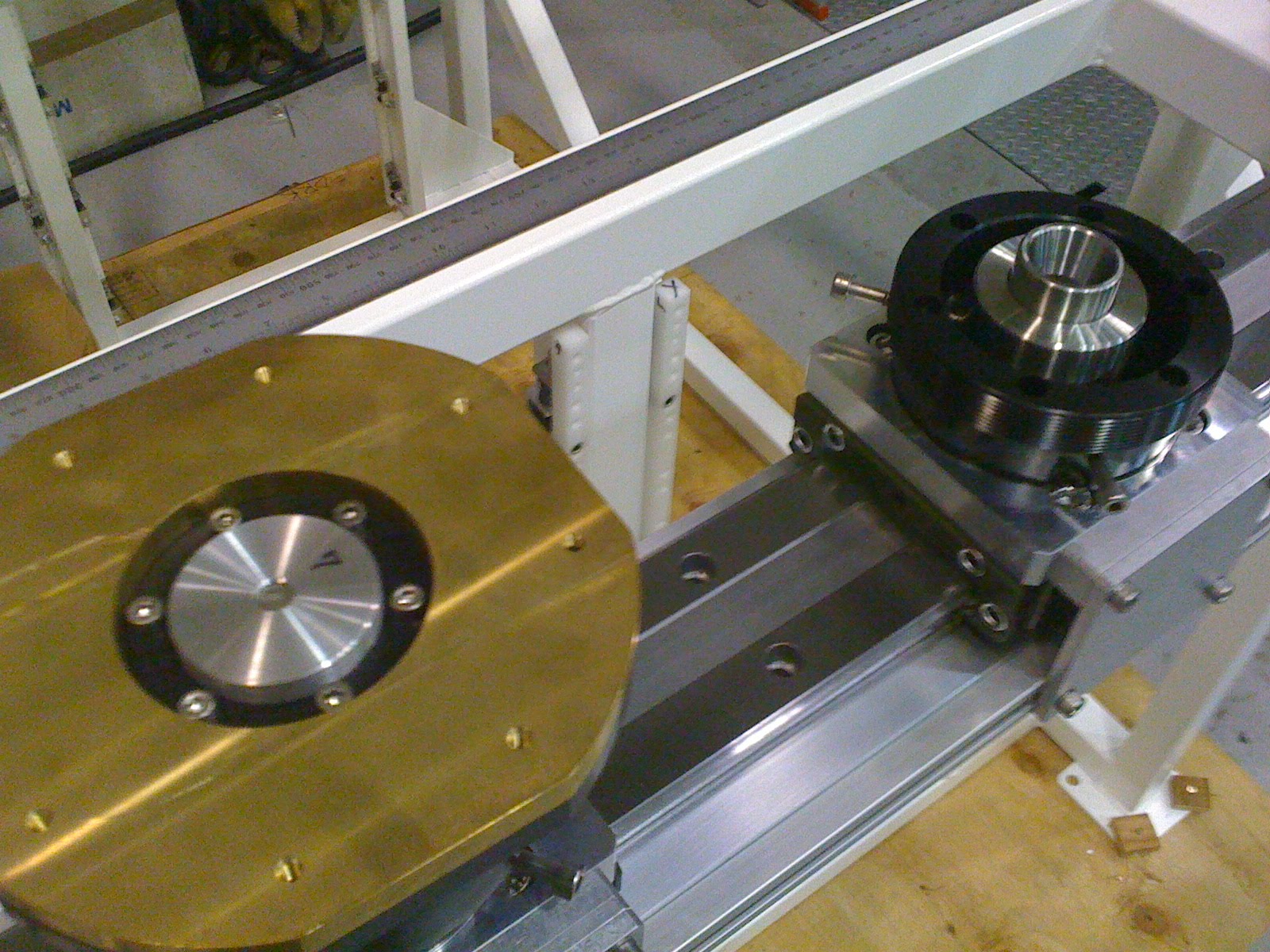
A lot of the optical mounts are therefore on stages driven by micrometers, and some of them need to be adjusted once in a while. Where it seems important and when we can afford it, we replace the manual micrometers by computer controlled actuators. Yesterday, Frédéric finished installing some of the Zaber linear actuators that we've chosen to do the job. The picture just shows a couple of these in-situ. The bench looks cooler and cooler everyday as we keep adding new hardware! Now, someone needs to finish writing the Python code that will talk to these actuators so that we can really computer control everything in SCExAO...